Build 001 · Freestyle · Grounded · video-path diagnosis
Source One V5 · 4S
A real 4S analog freestyle build based on the TBS Source One V5, now grounded while an intermittent frozen FPV image is diagnosed across the camera and analog video path.
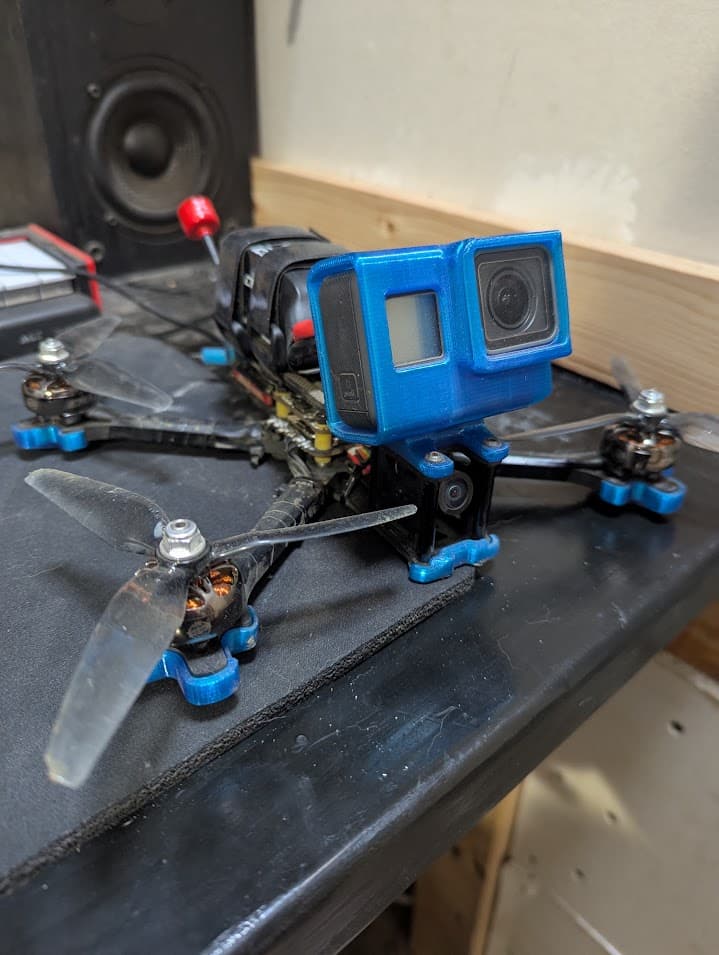 Earlier bench configuration · GoPro and mount have since been upgraded
- Airframe
- 5-inch
- Battery
- 4S · 1500mAh
- Video
- Analog · 5.8GHz
- Dry weight
- Unknown
01 · Purpose
A repairable 5-inch freestyle quad built as a hands-on platform for learning assembly, soldering, and FPV flight.
This build pairs a TBS Source One V5 frame with a 4S analog power and video system. It is the first real aircraft recorded in Drone Builder: not just a parts list, but a record of the knowledge and practice required to turn those parts into something flyable.
ChatGPT was used extensively during the build. Bacon Ninja FPV’s Source One material was especially useful for assembly and soldering even though the reference build was not identical; James remembers the video transmitter as the main variation. Joshua Bardwell’s build instruction and flight-learning videos were also important. Learning to fly took sustained practice rather than ending when assembly was complete.
02 · Assembly evidence
The imperfect photos preserve the work.
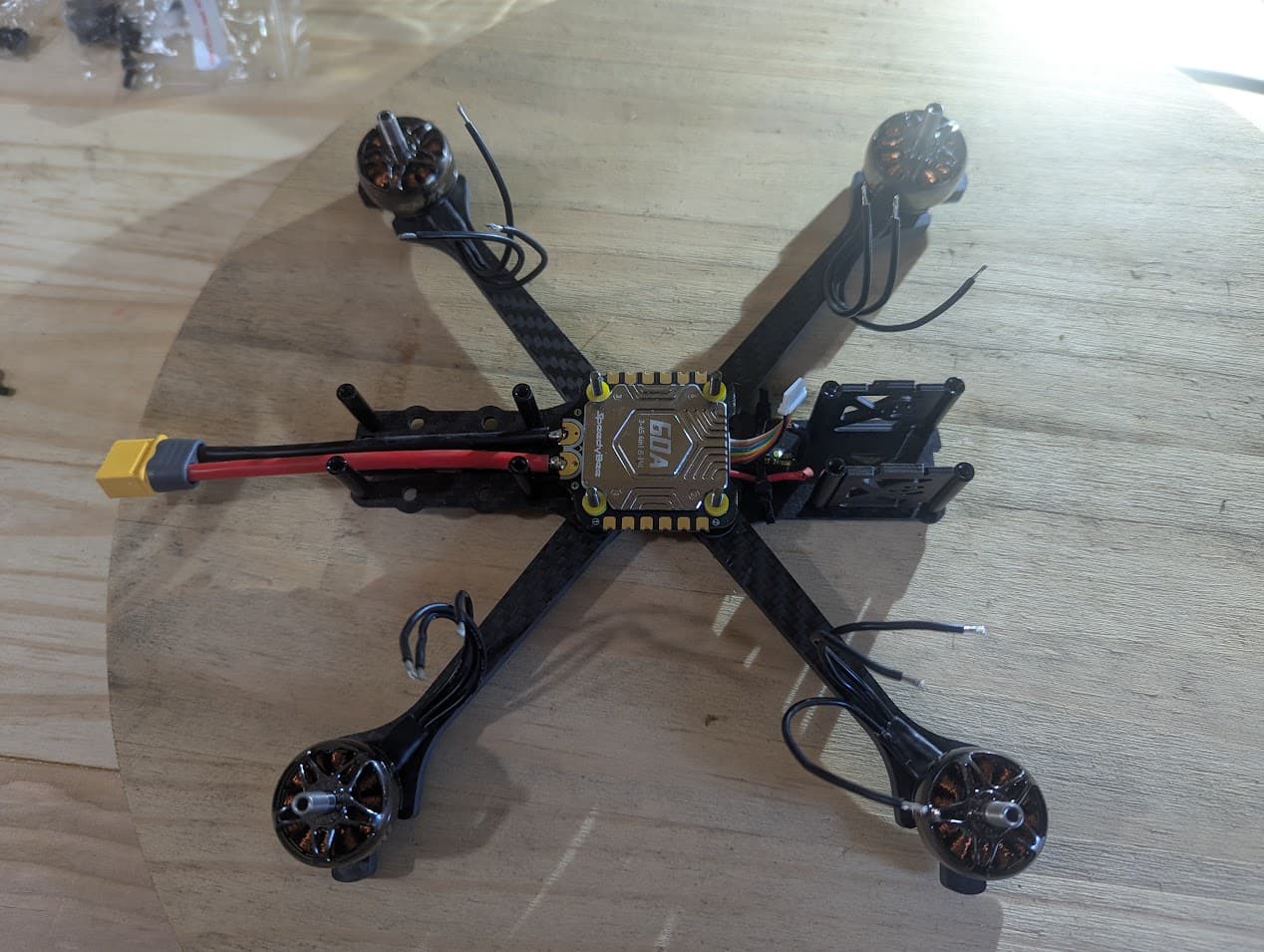
Early assembly: motors mounted, loose motor leads, and the SpeedyBee stack and XT60 power lead positioned.
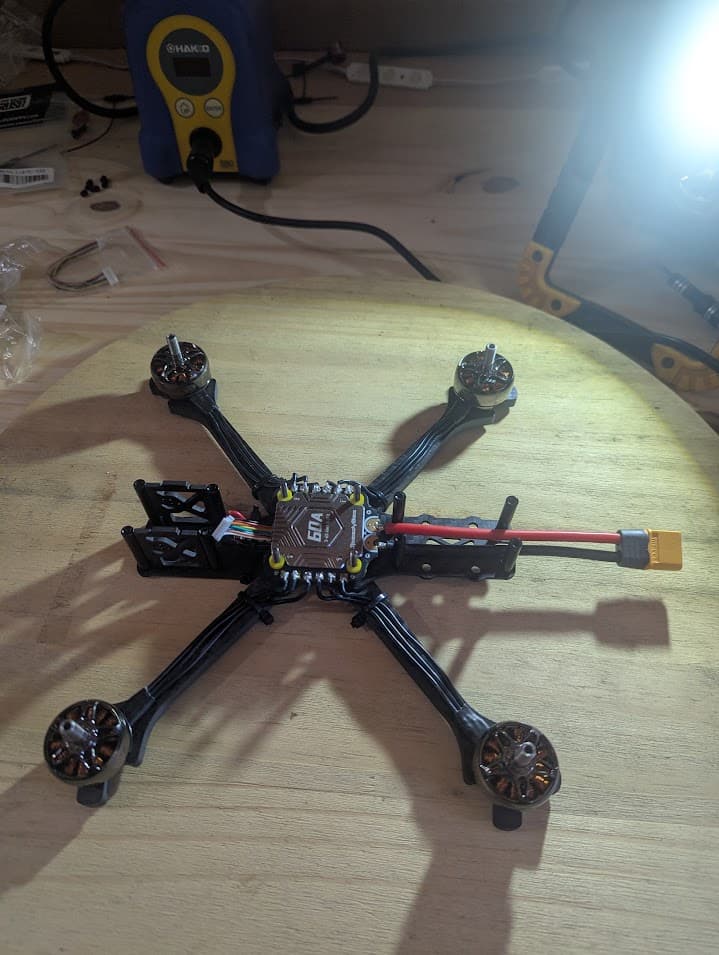
Same-day progress after the motor leads were routed and soldered around the outside edges of the ESC pads.
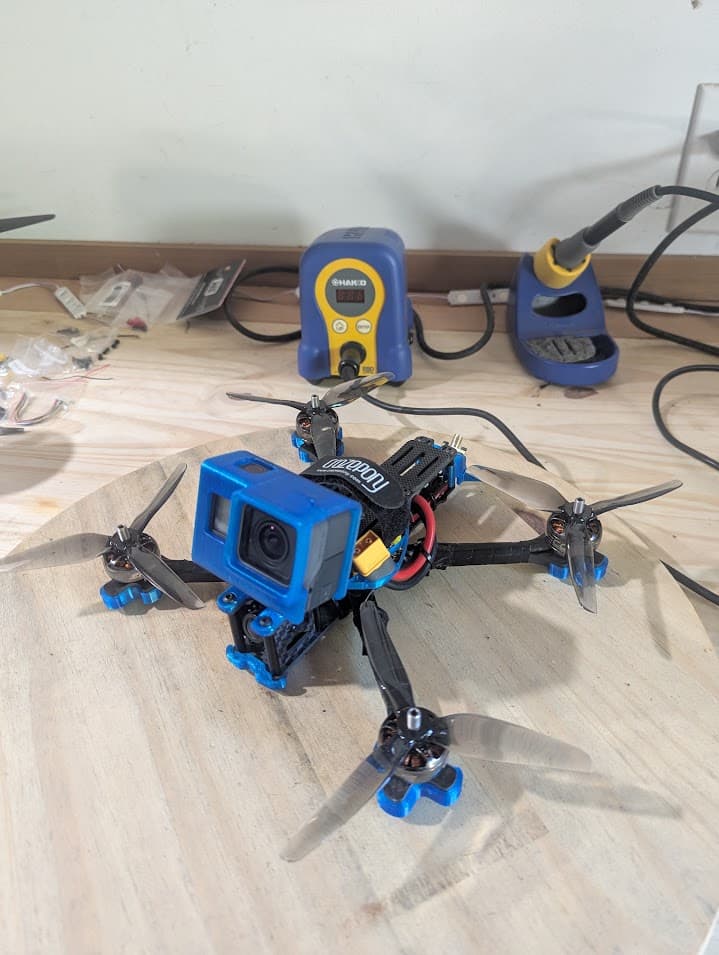
An early assembled configuration with props, battery strap, and the blue printed GoPro mount later replaced because of vibration.
A closer view of the early action-camera configuration before the GoPro and mount upgrade.
03 · Components
Parts used together.
| Role | Component | Evidence |
|---|---|---|
| Frame | TBS Source One V5 | verified |
| Motors | EMAX ECO II 2306 1900KV × 4 | verified |
| Flight controller + ESC | SpeedyBee F405 V3 BLS 60A 30×30 FC & ESC Stack | verified |
| Control receiver | Happymodel EP1 2.4GHz ExpressLRS nano receiver | verified |
| Video transmitter | RushFPV Rush Tank SOLO 1W 5.8GHz VTX | verified |
| FPV camera | RunCam Phoenix 2 Special Edition | verified |
| Video antenna | RushFPV Cherry2 5.8GHz RHCP antenna · straight MMCX | verified |
| Propellers | HQProp Ethix S5 Light Grey 5×4×3 tri-blade | verified |
| Battery | CNHL Black Series 1500mAh 4S 14.8V 130C XT60 | verified |
04 · Supporting equipment
Used with the aircraft.
RadioMaster Boxer ELRS
Regular Boxer with the internal 2.4GHz ExpressLRS radio system.
Fat Shark Echo analog FPV goggles
Recorded from the supplied purchase listing; Fat Shark currently identifies this model as Echo.
GoPro HERO13
Current action camera. The historical photographs show the earlier GoPro and high-vibration blue printed mount.
05 · Build notes
Details worth finding again.
06 · Incident evidence
Failures recorded without rewriting uncertainty.
Raw recordings remain outside Git. This record keeps the source identity, checksum, event timing, direct observations, pilot recollection, and current interpretation together.
Safety-critical · loss of pilot visual control
In-flight frozen FPV image followed by uncontrolled descent
The pilot observed the FPV image freeze at approximately 0:06. The GoPro records controlled flight immediately beforehand, followed by a sustained tumble and ground impact. The image did not recover until the aircraft was rebooted.
Evidence timeline
- GoPro shows controlled flight with no obstacle contact visible.
- Aircraft abruptly begins a sustained tumble, closely aligning with the reported FPV freeze.
- Ground impact; aircraft comes to rest.
Direct observations
- The GoPro continues recording normally throughout the event.
- No collision is visible immediately before the aircraft departs controlled flight.
- No goggles DVR has yet been found for this incident.
Pilot report
- FPV image froze at approximately 0:06.
- The symptom matched the later June incident.
- The live image did not recover until the aircraft was rebooted.
Current interpretation
- This is the stronger evidence that an immediate impact is not required to trigger the failure.
- The GoPro establishes the aircraft behavior and timing, but cannot independently prove what remained active in the goggles feed.
- Exact failed component remains unresolved.
Retained source files & checksums
Preserves controlled flight, onset of the sustained tumble, and impact. The embedded creation date reflects the later trim/export, not the flight date.
SHA-256 2beba03ea7cdae264a83a61655c2b84815195d994744f70139899b573de9366aDiagnostic evidence · OSD and RF remained active
Impact-associated camera or video-path freeze
Synchronized GoPro and goggles recordings show the camera background freeze at approximately the time of impact while Betaflight OSD continued to update. RF transmission persisted until aircraft power was interrupted, and live video returned only after reboot.
Evidence timeline
- Major roll and impact. Audio alignment places this close to the goggles freeze.
- Camera background stops updating abruptly.
- Betaflight post-flight statistics update over the frozen camera background.
- RF static appears when aircraft power is interrupted.
- Betaflight boot screen appears, followed by restored live video.
Direct observations
- The camera image froze, but live OSD changes remained visible over it.
- The goggles continued receiving the aircraft transmission until power interruption.
- Post-flight values appear to show approximately 14.92 V minimum battery, 12 A maximum current, 40 mAh used, and 00:19 arm time.
- The available evidence does not show an unusually large throttle or current event at the failure.
Pilot report
- An earlier crash occurred in the longer raw footage.
- The frozen image did not recover until the aircraft was power-cycled.
Current interpretation
- This was not a complete VTX or RF dropout: transmission and flight-controller OSD remained active.
- The likely fault boundary includes the FPV camera, its power/ground/video wiring, or the flight-controller video-input path.
- Because VTX-LOSS-002 occurred without an immediately preceding impact, impact may trigger the fault but is not required.
Configuration observed in evidence
- SmartAudio menu initially showed Raceband 8 at 5917 MHz.
- Displayed VTX power was 800 mW before later menu inspection changed the selected values.
- PIT mode displayed OFF.
Retained source files & checksums
Preserves the frozen camera background, continuing OSD, SmartAudio inspection, loss of RF at power interruption, and restored live video after boot.
SHA-256 98d13558d6a43d0c411df872066695416a88a8c8161d3650ba2cf9e658fd5562Preserves aircraft motion and impact for approximate alignment with the goggles DVR. The embedded creation date reflects the later trim/export.
SHA-256 ca78008dda8a54d8805f0a3e383a3c146782ad7a3b968404e0c8df99d36a826b07 · Skills & resources
The knowledge behind the build.
Soldering
Joining and inspecting the power, motor, receiver, camera, and video-transmitter connections required by a custom build.
Frame & electronics assembly
Turning separate airframe and electronics components into a serviceable working quad.
FPV flight
A substantial learning phase after the build itself; tutorial guidance and repeated practice were both important.
TBS Source One V5 complete assembly guide
Bacon Ninja FPV
Especially helpful for frame assembly and soldering. The reference aircraft was similar rather than identical; the VTX is the remembered main variation.
Beginner FPV drone build series
Joshua Bardwell
Detailed build instruction covering the path from separate parts toward a testable aircraft.
FPV flight-learning videos
Joshua Bardwell
Especially helpful during the long process of learning to fly.
Build assistance and troubleshooting
ChatGPT
Used extensively throughout parts questions, assembly decisions, and troubleshooting.
Simulator training
08 · Files & artifacts
The physical build has source files too.
Source One V5 GoPro mount
Binary STL · 9,292 facets · 454 KB
Supplied with the build record for the HERO13 mount. Source attribution, license, print material, slicer settings, and installed revision should be recorded before it becomes a public download.
artifacts/tbs-source-one-v5-4s/source-one-v5-gopro-mount.stl09 · Drone commits
State changes, not overwritten history.
- Date unknown
Initial build
Assembled the Source One V5 around the SpeedyBee stack, EMAX motors, analog video system, and ExpressLRS control link.
- 2025-07-15
Stack and motor-wire assembly
Progress photos preserve the loose-lead state and the later same-day routing and soldering around the outside of the ESC pads. The geometry became a lesson worth revisiting.
- 2025-07-22
Early GoPro configuration
The assembled aircraft was photographed with props, battery strap, and the blue printed GoPro mount that later proved to have substantial vibration.
- 2025-08-03
Earlier bench configuration
Photographed on the bench with the earlier GoPro and blue printed mount. The capacitor was packaged between the FPV camera and flight controller because space was limited.
- Date unknown
GoPro & mount upgrade
Replaced the earlier high-vibration action-camera setup with a GoPro HERO13 and a different printed mount. The model file is retained; print settings and installed revision remain to be recorded.
- After initial build
Flight-learning phase
The aircraft became a continuing practice platform. Most simulator training happened in DRL; Liftoff is now used for continued practice.
- 2025-09-27
VTX-LOSS-002 · in-flight image freeze
The FPV image reportedly froze during otherwise controlled flight. GoPro evidence shows the aircraft enter a sustained tumble at approximately the reported freeze time and impact several seconds later. No immediately preceding collision is visible; recovery required an aircraft reboot.
- 2026-06-11
VTX-LOSS-001 · OSD continued over frozen image
Companion GoPro and goggles recordings captured another nonrecovering freeze. Betaflight OSD and RF transmission remained active over the frozen camera background, narrowing the diagnostic boundary away from a complete VTX dropout.
- 2026-08-24
Incident evidence correlated
Preserved clip metadata, checksums, synchronized event timing, observations, pilot reports, and diagnostic interpretations for both known frozen-image incidents. Raw video remains outside Git.
- Current
Grounded for video-path diagnosis
At least two nonrecovering FPV image freezes are now documented. Because dependable live video is required for safe flight, the aircraft remains grounded until the camera/video-path fault is isolated, corrected, and verified.
- Current
Bench modification pass
The aircraft is currently on the bench undergoing modifications. The parts changed, reasoning, and result will be added as the work progresses.